Cybersecurity

Understanding the Requirements to Qualify for Microsoft GCC and GCC High

Organizations that work with United States government agencies or handle sensitive government data often require cloud environments that meet elevated security and compliance standards. Microsoft offers two specialized government cloud environments to support these needs: Government Community Cloud (GCC) and Government Community Cloud High (GCC High).

While both environments are designed for regulated workloads, not every organization is eligible to use them. Understanding the qualification requirements is a critical first step before planning a migration or modernization effort.

This article outlines the eligibility criteria, documentation requirements, and compliance considerations for organizations seeking to adopt GCC or GCC High.


Overview of Microsoft Government Cloud Environments

Microsoft’s government cloud offerings are segmented to align with different levels of sensitivity and regulatory oversight.

GCC is designed for U.S. federal, state, local, and tribal government entities, as well as contractors that support them. GCC High is designed for organizations that handle highly sensitive data, including Controlled Unclassified Information (CUI), Federal Contract Information (FCI), and export-controlled data.

Each environment operates within separate infrastructure and enforces specific access, residency, and compliance controls.


Eligibility Requirements for Microsoft GCC

To qualify for Microsoft GCC, an organization must meet one or more of the following criteria:

  • Be a U.S. federal, state, local, or tribal government agency
  • Be a contractor or partner that supports U.S. government agencies
  • Be an organization that processes or stores government-regulated data on behalf of a public sector entity

In addition to organizational purpose, Microsoft requires that customers demonstrate a legitimate government use case for GCC services.

Verification and Documentation

Organizations seeking GCC access must complete Microsoft’s government cloud eligibility validation process. This typically includes:

  • Submission of organization details and government affiliation
  • Verification of contracts, grants, or partnerships with government entities
  • Validation of domain ownership and tenant information

Once approved, the organization may provision a GCC tenant and access supported Microsoft services within the government cloud environment.


Eligibility Requirements for Microsoft GCC High

GCC High has more stringent requirements due to the sensitivity of the data it is designed to protect.

To qualify for GCC High, an organization must meet at least one of the following conditions:

  • Be a U.S. federal agency or department
  • Be a defense contractor or subcontractor handling CUI or FCI
  • Be subject to regulations such as DFARS, ITAR, CMMC, or NIST SP 800-171
  • Handle export-controlled or law enforcement sensitive information

In addition, organizations must demonstrate that GCC High is required to meet contractual or regulatory obligations, not simply as a preference.

Citizenship and Data Residency Requirements

A defining characteristic of GCC High is that customer data is stored within the United States and managed by screened U.S. persons. Microsoft enforces strict access controls to ensure only authorized U.S. personnel can administer the environment.

Organizations must be prepared to align their own administrative access and support models with these requirements.


Contractual and Compliance Alignment

Eligibility alone is not sufficient to operate successfully in GCC or GCC High. Organizations must also demonstrate alignment with applicable compliance frameworks.

Common regulatory drivers include:

  • NIST SP 800-171 for protecting Controlled Unclassified Information
  • CMMC requirements for Defense Industrial Base contractors
  • DFARS clauses related to safeguarding government data
  • HIPAA and CJIS for organizations supporting healthcare or criminal justice workloads

Organizations should be prepared to map their security controls, policies, and procedures to these frameworks before and after migration.


Technical and Operational Readiness Considerations

Meeting GCC or GCC High requirements also involves operational readiness.

Organizations should evaluate their identity and access management practices, including the use of multi-factor authentication and privileged access controls. Endpoint security, logging, and incident response capabilities must align with government cloud expectations.

Additionally, not all third-party applications and integrations are compatible with GCC or GCC High. A thorough review of dependencies is required to avoid operational disruptions.


Approval Process and Timeline

Microsoft’s approval process for government cloud access is not instantaneous. Depending on organizational complexity and documentation readiness, approval can take several weeks.

Organizations should plan accordingly and avoid committing to aggressive migration timelines until eligibility has been confirmed and tenants are provisioned.


Common Misconceptions About GCC and GCC High

One common misconception is that any organization can choose GCC or GCC High for added security. In reality, access is restricted to organizations with verified government use cases.

Another misconception is that GCC High automatically ensures compliance. While the platform provides compliant infrastructure, organizations are still responsible for configuring controls, managing access, and maintaining compliance over time.


How Rolle IT Cybersecurity Helps Organizations Qualify and Succeed

Navigating GCC and GCC High eligibility can be complex, particularly for contractors and regulated organizations new to government cloud environments.

Rolle IT Cybersecurity assists organizations by validating eligibility, preparing documentation, aligning compliance requirements, and designing secure architectures tailored to GCC or GCC High. Our team supports organizations throughout the approval, migration, and operational phases to ensure long-term compliance and security.


Conclusion

Microsoft GCC and GCC High provide secure cloud environments tailored to the needs of government agencies and contractors, but access is limited to organizations that meet specific eligibility and compliance requirements.

By understanding qualification criteria, preparing documentation, and aligning security operations with regulatory standards, organizations can confidently adopt the appropriate government cloud environment to support their mission.

Organizations considering GCC or GCC High should engage experienced security and compliance partners early to reduce risk and accelerate success.

Important Notes on Eligibility Determination

  • Eligibility is determined by Microsoft and requires formal validation.
  • Preference for enhanced security alone is not sufficient justification.
  • Approval timelines may vary depending on documentation readiness and organizational complexity.
  • Eligibility does not guarantee compliance; proper configuration and ongoing governance are required.

Understanding the Requirements to Qualify for Microsoft GCC and GCC High Read More »
Best Practices for Implementing Microsoft GCC High

A Guide for Defense Contractors

Executive Summary

Organizations that handle sensitive government information are increasingly required to meet stringent cybersecurity and compliance standards while maintaining operational efficiency. Microsoft Government Community Cloud High, known as GCC High, is designed to support these requirements by providing a secure, sovereign cloud environment for United States government agencies and authorized contractors. Rolle IT helps appropriate organizations procure and deploy GCC High environments.

Successful implementation of GCC High requires more than technical migration. It demands a structured approach that integrates compliance frameworks such as NIST SP 800-171 and CMMC, strong identity and access controls, secure configuration standards, and continuous monitoring. This document outlines best practices to help organizations deploy GCC High in a manner that is secure, compliant, and sustainable.

By following these practices, organizations can reduce risk, maintain audit readiness, and enable secure collaboration for users handling Controlled Unclassified Information and Federal Contract Information.


Understanding GCC High and Its Purpose

Microsoft GCC High is a sovereign cloud environment built specifically for United States government agencies and authorized contractors. It supports compliance with frameworks and regulations such as DFARS, CMMC, NIST SP 800-171, ITAR, CJIS, and HIPAA. The environment features segregated infrastructure, enhanced access controls, and United States-based data residency.

Due to its elevated security posture, GCC High deployments require deliberate design decisions to ensure both compliance and usability.


Conduct a Compliance-Driven Readiness Assessment

Prior to implementation, organizations should perform a readiness assessment focused on compliance and risk.

Key areas to evaluate include data classification, regulatory obligations, and the current technical environment. This includes identifying where Controlled Unclassified Information and Federal Contract Information reside, determining which compliance frameworks apply, and reviewing identity, endpoint, and network security controls already in place.

This assessment provides the foundation for a GCC High architecture aligned with both security and business requirements.


Establish Strong Identity and Access Controls

Identity is the cornerstone of a secure GCC High environment. Organizations should implement Azure Active Directory Conditional Access policies to enforce access based on user risk, device compliance, and contextual factors. Multi-factor authentication should be enabled for all users without exception.

Privileged access should be tightly controlled using role-based access control and Privileged Identity Management. Administrative roles should be segmented to reduce the risk of unauthorized access and insider threats.


Apply Secure Configuration and Hardening Standards

Although GCC High includes enhanced default protections, additional hardening is essential.

Organizations should apply Microsoft-recommended security baselines for GCC High workloads and adopt Zero Trust principles that continuously verify user identity, device health, and application context. Endpoint security should be enforced using tools such as Microsoft Defender for Endpoint and Intune to ensure devices accessing GCC High resources meet compliance requirements.

Implementing secure configurations early helps avoid operational disruptions and costly remediation later.


Plan and Sequence Workload Migrations Carefully

Not all workloads are immediately suitable for GCC High. Organizations should define a phased migration strategy that prioritizes critical services such as email, collaboration tools, and document management systems.

Dependencies on third-party applications should be reviewed carefully, as some vendors may not support GCC High environments without modification. Custom applications may require redesign or reconfiguration to integrate securely.

A phased approach reduces risk and minimizes disruption to business operations.


Implement Robust Data Governance Controls

Data governance is essential for maintaining compliance and protecting sensitive information.

Organizations should use sensitivity labels to identify and protect Controlled Unclassified Information, enforce retention and deletion policies, and ensure encryption is applied appropriately. Legal hold, eDiscovery, and audit capabilities should be validated prior to production use.

Effective data governance supports both regulatory compliance and operational accountability.


Validate the Environment Through Testing

Before full production deployment, organizations should conduct thorough testing using real-world scenarios.

This includes piloting GCC High access with select user groups, validating collaboration workflows, and testing security controls. Threat simulations and tabletop exercises help verify incident response procedures and monitoring effectiveness.

Testing ensures the environment performs as expected and supports secure day-to-day operations.


Provide Training for Users and Administrators

Security controls are only effective when users and administrators understand how to operate within them.

End users should receive training on secure collaboration, phishing awareness, and multi-factor authentication usage. Administrators should receive advanced training on identity governance, security monitoring, and compliance management.

Clear documentation and operational playbooks should be developed to support onboarding, incident response, and audits.


Operationalize Continuous Monitoring and Threat Detection

GCC High provides extensive logging and telemetry, but organizations must actively monitor and respond to security events.

Security operations should include continuous monitoring through Microsoft Defender and Microsoft Sentinel, real-time alerting for suspicious activity, and routine reviews of access and configuration changes.

Ongoing monitoring ensures threats are identified and addressed before they impact sensitive systems.


Maintain Continuous Compliance Posture

Compliance is not a one-time effort. Organizations should regularly assess their control posture against applicable frameworks such as NIST SP 800-171 and CMMC.

Compliance dashboards, control mappings, and periodic reviews help maintain audit readiness and identify gaps early. Policies and configurations should be updated as regulations and threat landscapes evolve.


Engage Experienced GCC High Security Partners

Implementing and operating GCC High requires expertise across cloud architecture, cybersecurity, and regulatory compliance. Many organizations benefit from working with partners experienced in securing government and defense workloads.

Rolle IT Cybersecurity supports government agencies and federal contractors by delivering GCC High readiness assessments, secure architecture design, workload migration, and continuous security monitoring aligned with federal compliance requirements.


Microsoft GCCH Deployment

Microsoft GCC High provides a powerful platform for protecting sensitive government data, but its effectiveness depends on thoughtful implementation and disciplined operations. By following structured best practices across identity, security configuration, governance, and monitoring, organizations can achieve compliance while enabling secure, modern collaboration.

For organizations seeking to implement or optimize GCC High, Rolle IT Cybersecurity offers the expertise and operational support required to secure mission-critical environments.

CMMC@RolleIT.com 321-872-7576

Best Practices for Implementing Microsoft GCC High Read More »

A Strategic Microsoft Partner for GCC High Environments

For organizations already operating under Microsoft 365 GCC High (GCCH) requirements, the primary challenge is not determining whether GCCH is needed, but ensuring it is implemented, governed, and sustained correctly.

Rolle IT supports executive leadership and procurement stakeholders by providing structured oversight and long-term partnership for GCC High environments, reducing operational risk and ensuring contractual obligations are met.


Executive and Procurement Priorities

Organizations required to operate in GCC High face several non-negotiable priorities:

  • Proper eligibility validation and license issuance
  • Secure, defensible tenant configuration
  • Alignment with contractual and regulatory obligations
  • Audit readiness and documentation support
  • Long-term operational sustainability

Rolle IT works with leadership teams to ensure these priorities are addressed consistently and deliberately, without introducing unnecessary complexity or risk.


Rolle IT’s Role as Your GCC High Partner

Rolle IT acts as a governance-focused Microsoft partner, supporting GCC High environments throughout their lifecycle.

Our role includes:

  • Eligibility and Licensing Assurance
    Supporting accurate qualification, documentation, and license procurement through authorized channels.
  • Tenant Architecture and Governance Advisory
    Advising on administrative structure, identity strategy, and access models aligned with security and compliance expectations.
  • Security and Compliance Alignment
    Ensuring GCC High configurations support requirements such as NIST SP 800-171, DFARS, ITAR, and CJIS, where applicable.
  • Operational Readiness and Continuity
    Supporting adoption, change management, and long-term sustainability within the GCC High environment.

This approach enables leadership to make defensible, well-informed decisions.


Designed for Oversight and Accountability

GCC High environments must withstand scrutiny—from auditors, assessors, and contracting authorities.

Rolle IT emphasizes:

  • Clear governance models
  • Documented configuration decisions
  • Repeatable security practices
  • Reduced reliance on ad-hoc or reactive changes

This structure supports accountability and reduces long-term risk.


Engagement Beyond Initial Implementation

GCC High is not a one-time project. Licensing changes, new users, evolving contracts, and assessments introduce ongoing demands.

Rolle IT remains engaged to support:

  • Licensing lifecycle management
  • Configuration and governance reviews
  • Audit and assessment preparation
  • Strategic guidance as requirements evolve

Our clients value continuity and institutional knowledge, not one-time delivery.


A Partner for Leadership and Procurement Teams

Rolle IT complements internal IT organizations by providing specialized expertise and advisory support where it matters most. We help leadership and procurement teams move forward with confidence, clarity, and documented assurance.


Partner with Rolle IT

For organizations already committed to GCC High, selecting the right Microsoft partner is a critical governance decision.

Rolle IT provides the oversight, experience, and continuity required to operate GCC High environments with confidence and control.

Info@rolleit.com 321-872-7576

A Strategic Microsoft Partner for GCC High Environments Read More »

Its Always DNS

DNS Outages Are a Business Redundancy Wake-Up Call

Recent internet disruptions caused by DNS failures have highlighted something every organization needs to take seriously: even the biggest players in the world can go down without warning. For businesses that rely on cloud tools, communications platforms, remote operations or online services, DNS outages are not just an IT problem. They are a business continuity risk.

Is it DNS?

Recent DNS Related Outages Show the Risks

  • In October 2025, Amazon Web Services experienced a DNS related issue that disrupted major services in its US-EAST-1 region. Businesses that depended on AWS suddenly found key systems unreachable.
  • In July 2025, Cloudflare’s 1.1.1.1 DNS resolver went offline worldwide for almost an hour, preventing millions of users from accessing websites and cloud applications.
  • In November 2025, another DNS related event affected thousands of sites, again proving that a single DNS system failure can ripple across the entire internet.

These were not small companies with outdated infrastructure. These are some of the largest, most advanced providers in the world. If they can suffer DNS failures, any business can be impacted.

Why DNS Issues Threaten Business Redundancy

DNS is a critical layer of redundancy that many organizations forget to plan for. When DNS fails:

  • Redundant servers do not matter if users cannot reach them
  • Cloud failover does not activate because DNS cannot direct traffic
  • Communication systems and customer portals become unreachable
  • Revenue producing systems stop functioning
  • Employees cannot access essential tools or data

A single weak point in DNS can quietly undermine every other redundancy strategy a business has invested in.

How a Tier 3 IT Team Like Rolle IT Strengthens Redundancy

This is where advanced expertise becomes essential. Rolle IT, provides the deep technical skills required to build and support real redundancy across DNS, networking and cloud environments.

A strong Tier 3 team can:

  • Architect redundant DNS providers and failover paths
  • Detect DNS resolution issues before they become outages
  • Apply advanced monitoring and real-time troubleshooting
  • Configure DNS to support high availability systems
  • Restore resolution quickly during an incident
  • Review and harden your environment to prevent repeat failures

Business redundancy is only as strong as its least resilient component. DNS is often that overlooked component until something breaks.

Partnering With Experts Protects Your Business

The recent outages across AWS, Cloudflare and other major platforms make one message clear. Businesses must invest in the right expertise to ensure continuity, resilience and uptime. Rolle IT’s Tier 3 engineers help organizations design redundant, fault-tolerant systems that keep operations running even when the unexpected happens.

If you want help strengthening your DNS strategy and overall resilience, Rolle IT is ready to support you.

Its Always DNS Read More »

Active Directory Secure Backup

An estimated 90% of today’s cyberattacks target Active Directory. It’s no surprise, given that AD is the gateway to your entire digital infrastructure.

A single AD breach enables bad actors with a centralized location to take control, deny access to critical applications and data, and even bring your entire network-and business-to a standstill.

That’s why the protection and recoverability of AD is a top priority for Rolle IT’s clients.

Rolle IT leverages Commvault’s Cloud Backup & Recovery for Active Directory bringing resilience to your entire digital infrastructure. Let’s talk about how we can help secure your critical identity services.

CMMC Compliant Services, as well as commercial platforms available.

Info@Rolleit.com to learn more.

Active Directory Secure Backup Read More »

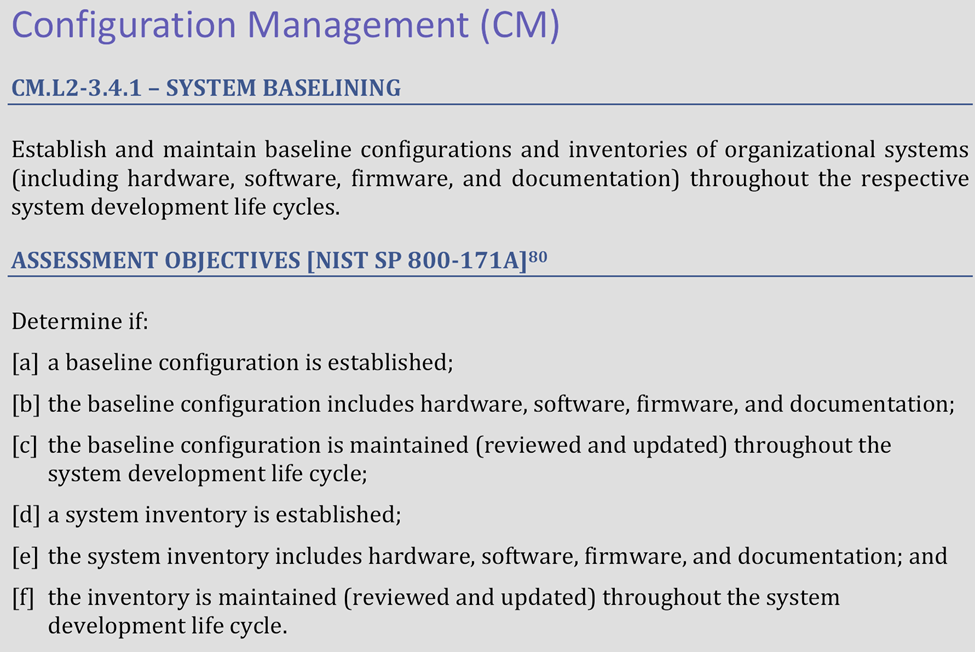
Top 10 Failed CMMC Controls, #10 System Baselining

CMMC Journey Guides

#10- CM.L2-3.4.1: System Baselining

When working with individual controls, we know that they have to be dissected from an objective level. For this specific control out of the 110 controls, 320 objectives in CMMC, I have chosen to split it up with objectives a/b/c and d/e/f. Two parts, mainly covering “baseline configurations” and “system inventory”. If you work with CUI, you don’t get to “wing it” on configurations or inventory. CM.L2-3.4.1 asks you to do two big things across the system life cycle:
(1) build and maintain secure, documented baselines for each system and
(2) keep a trustworthy inventory that actually reflects reality in production.

The CMMC Level 2 Assessment Guide spells this out clearly, including exactly what assessors will “Examine/Interview/Test” to verify it’s in place. In this article we will get granular with 1) Dissecting the Control, 2) What full implementation looks like, 3) Why this Control Fails, 4) A Quick Checklist.

1) Dissecting The Control in Two Logical Halves

Objectives A/B/C: Baseline Configurations

  • [a] Establish a baseline configuration for each system component type. For every deployed machine type, you define the approved build: OS version, required apps, hardened settings, network placement, and anything else that affects security and function.
  • [b] Include the full buildout for each system. Baselines must cover hardware, software, firmware, and documentation—not just a golden image. Think platform model/BIOS, OS and app versions/patch status, and the config parameters that lock it down.
  • [c] Maintain it consistently moving forward. As your environment changes, review and update baselines so they always reflect the live system and enterprise architecture (create new baselines when things change materially).

What lives in a solid baseline:

  • Laptops/Desktops/Servers
  • Enclaves (e.g., entire VDI and each component), laptops/workstations, servers
  • ALL Applications per asset group
  • Versions & patch levels for OS/apps/firmware
  • Networking elements: routers, switches, firewalls, WAPs, etc.

Objectives D/E/F: System Inventory

  • [d] Establish a system inventory. A real one… no, seriously. This is ideally software via Asset Management agent(s) that automate most of this process. BUT that is not required, just advice. Any devices classified as any of the CMMC asset types will be in-scope and should be in the system inventory.
  • [e] Include the full buildout for each system in the inventory. (again: hardware, software, firmware, and documentation).
  • [f] Maintain it. Review and update it as systems evolve so it stays accurate to production reality in a reasonable and timely manner.

What lives in a solid inventory:

  • Manufacturer, device type, model, serial number, physical location, owners/main users
  • Hardware specs & parameters
  • Software inventory with version control and potentially licensing information
  • Network info (machine names, IPs)

Assessor angle (what they look at): Policies, procedures, SSP, Configuration Management plan, inventory records and update logs, config docs, change/install/remove records; plus, interviews with the people who build and maintain these things; plus, tests of the actual processes and mechanisms you use to manage baselines and the inventory.

2) What Full Implementation Looks Like

A simple, effective pattern from the Assessment Guide:

  1. Design a secure workstation baseline. Research the hardened settings that deliver the least functionality needed to do the job, then test that baseline on a pilot machine.
  2. Document it (build sheet, settings, required software, version list, how it’s joined to the network) and roll it out to the rest of that asset class from the documented baseline.
  3. Update the master inventory manually, or make sure an appropriate agent is live to reflect the software changes and the devices now at the new baseline.
  4. Schedule a regular review interval to re-validate versions, patches, and settings; or make review a normal part of your SOP that is updated on a regular basis.

Scale that approach across all deployed machine types:

  • Enclaves & Virtual Desktop Infrastructure: baseline the image and each supporting component (connection brokers, secure gateways, user-profile layers, and file-system layers).
  • Laptops & Workstations: document hardware models and BIOS/UEFI versions, OS build, required apps, GPOs/MDM profiles.
  • Servers: OS baselines per role (AD/DNS, file, app, DB), service hardening, approved modules/agents.
  • Networking: switch/router/Firewall/WAP firmware baselines, approved feature sets and templates.
  • Applications Inventory: version standards, required configs, and how they’re deployed/updated.
  • Docs: build guides, change records.

And yes, tie everything to change management controls, because the second you patch, you either (1) update the baseline or (2) record an approved deviation and a plan to reconcile. The guide’s “Potential Assessment Considerations” call out version/patch levels, configuration parameters, network info, and communications with connected systems (proof for [a]/[b]), and timely baseline updates ([c]).

How computers are actually baselined, end-to-end:

  1. Procurement & intake: approve models; capture serials/asset tags at receipt; record ownership/location.
  2. Imaging: apply the gold image (or Autopilot/MDT/SCCM/Intune flow); inject drivers; enforce policies (GPO/MDM).
  3. Hardening: apply CIS/NIST-inspired settings that match your baseline; lock services/ports/protocols; set logging.
  4. Application set: install required software; check licensing; verify versions.
  5. Join & place: join to domain/MDM; put it in the right OU/MDM group/VLAN/segmented subnet.
  6. Recordkeeping: update the inventory with HW/SW/firmware/docs and network details; save the build sheet and sign-off.
  7. Review cadence: calendar-based (e.g., quarterly) and/or event-based (whenever a major patch lands) to keep baseline and inventory current ([c], [f]).

3) Why This Control Fails (Top-10, sitting at #10)

Short answer: it’s a lot of work. and it’s the kind that doesn’t scream until something goes terribly wrong…

  • Documentation feels heavy. A real baseline covers hardware, software, firmware, and documentation and needs regular updates. That is inherently more than “we have an image.” It is buildout documentation, version matrices, network placement, and the approval trail that shows the baseline evolved with your environment.
  • Inventory discipline gets neglected. Many shops run with a “good enough” list. CMMC expects manufacturer, model, serial, location, owner, license/version data, and network identifiers; and expects you to keep it aligned to reality. If the list doesn’t match what’s plugged in, you’ll feel it during interviews and evidence review… and potentially a failed assessment.
  • Change is constant. Patches, feature updates, firmware drops, and hardware refreshes mean your baseline and inventory are living artifacts. If you don’t have a trigger to update both when changes roll out, drift creeps in, and you’ll miss [c]/[f] maintenance requirements.
  • Historical culture. Plenty of orgs “got by” without rigorous Change Management and Asset Inventory. CMMC is forcing the shift from tribal knowledge to documented, reviewable practice. Assessors will Examine/Interview/Test to verify it’s not just policy on paper.
  • Tool sprawl and ownership ambiguity. If imaging is owned by one team, firmware by another, and inventory by a third, gaps appear. You need clear roles and a single source of truth that each team updates as part of their workflow (again, the guide’s methods target exactly these mechanisms).

4) A Quick checklist you can actually use:

  • A baseline configuration exists for each asset class (VDI, laptop/WS, server roles, network devices, key apps) with:
    • Versions/patch levels, hardened settings, required software, network placement, and rationale (A/B).
    • An update log proving periodic and event-driven reviews (C).
  • A system (asset) inventory exists and matches production, with HW/SW/firmware/docs and the who/where/how (D/E).
  • A cadence (calendar + change triggers) keeps both baseline and inventory in sync with reality (F).
  • Evidence on hand for assessors: policies, CM plan/SSP, build sheets, images/scripts, install/removal/change records, inventory review logs, asset inventory dashboards, and interviews with the people who actually do the work (the assessment guide lists these explicitly).


Sources:

  • CMMC Assessment Guide – Level 2, CM.L2-3.4.1 (practice statement, objectives a–f, methods, discussion, example).
  • NIST SP 800-171A, 3.4.1 (assessment objectives and methods).
  • NIST SP 800-171r2, 3.4.1 discussion (what belongs in baselines and inventories).

Top 10 Failed CMMC Controls, #10 System Baselining Read More »

Outsourcing Compliance and MSP Support is the Smart Choice

The Compliance Challenge

For defense contractors, achieving and maintaining CMMC compliance isn’t optional—it’s the key to winning and keeping Department of War (DoD) contracts. But staying compliant is complex, time-consuming, and expensive if handled in-house:

  • Detailed Requirements and Configurations: Rolle IT MSSP Administrators are experienced and well versed in CMMC compliant configurations.
  • High Costs: Hiring full-time compliance, cybersecurity, and IT operations staff is not always cost effective for small and medium size businesses.
  • Resource Drain: Managing all IT, Compliance and Cybersecurity needs in house diverts attention from your core mission of serving the DoD
  • Audit Stress: Gathering evidence and maintaining documentation consumes valuable time.

The Smart Choice: Outsource to Rolle IT Cybersecurity

Outsourcing to Rolle IT means you get compliance expertise + 24/7 cybersecurity protection without the overhead of building it all yourself.

Benefits of Outsourcing:

Lower Cost, Higher Value

  • Pay only for the services you need—far less than hiring a full cybersecurity, compliance, and IT operations team.

Always Audit-Ready

  • We map technical controls directly to your SSP and CMMC requirements and maintain documentation, so you’re prepared when auditors arrive.

Specialized Expertise

  • Our MSSP services are designed for the Defense Industrial Base (DIB) and backed by CMMC, NIST 800-171, and DFARS expertise.

More Than An Internal Team

  • Instead of relying on one or two internal hires, Rolle IT delivers a full team of subject matter experts across compliance, cybersecurity, and IT operations.
  • Our team brings diverse skills—policy, monitoring, threat intelligence, forensics—that a couple of associates simply can’t match.
  • Greater efficiency: Less reliance on outside contractors since we cover more domains in-house.

Better Buying Power

  • As an MSSP, we can procure software licenses, cybersecurity tools, and hardware at negotiated rates—saving you money compared to going it alone.
  • Existing relationships with CMMC compliant Tools and FedRamp High Certified tools allows easier implementation and shorter ramp up times.

24/7 Monitoring & Protection

  • Our CrowdStrike-powered SOC detects and stops threats in real time—keeping you compliant and secure.

Focus on Your Core Business

  • You deliver for the DoD, while we handle compliance and cybersecurity.

Why Rolle IT?

  • Defense-Grade MSSP: Serving the DIB with CMMC-ready services.
  • Compliance-First Approach: Every service mapped to CMMC controls.
  • Scalable Solutions: From readiness assessments to full compliance-as-a-service.
  • Trusted Partner: A team dedicated to keeping you contract-eligible.

Take the Next Step

Don’t let compliance hold you back from DoD opportunities.
Partner with Rolle IT and stay secure, audit-ready, and competitive.

CMMC@Rolleit.com

Outsourcing Compliance and MSP Support is the Smart Choice Read More »

DoD’s 48 CFR Final Rule Reaches OIRA Review & is Cleared

On July 22, 2025, the Department of Defense took a major step toward finalizing its long-anticipated 48 CFR (DFARS) rule implementing the Cybersecurity Maturity Model Certification (CMMC). The rule was officially submitted to the Office of Information and Regulatory Affairs (OIRA) for interagency review.

This submission marks the last checkpoint before the rule is published in the Federal Register and becomes binding on contractors. Once cleared by OIRA, DoD can move forward with inserting the updated DFARS requirements into new solicitations and contracts.

What Comes Next

  • OIRA Review: OIRA cleared it on August 25, 2025. 
  • Federal Register Publication: The rule will be published in the Federal Register along with an official effective date. Federal regulations generally become enforceable within 1 to 60 days of publication.
  • Contract Implementation: Contractors can expect DFARS clauses referencing the CMMC requirements to begin appearing in solicitations as early as late 2025.

Why It Matters

This milestone carries real implications for defense contractors. Once the rule takes effect, companies that lack a CMMC-certified environment may find themselves ineligible to win or execute DoD contracts. It won’t be enough to have plans in place—contracting officers will need assurance that sensitive Department of Defense work is performed within a secure, certified environment.

For many small and mid-sized businesses, this could mean the difference between maintaining a foothold in the Defense Industrial Base or being locked out of future opportunities. Companies that have delayed compliance run the risk of being passed over in favor of competitors who are audit-ready.

Final Thought

For defense contractors, this is the clearest signal yet that CMMC compliance is no longer optional or “someday.” With the rule in OIRA’s hands, the countdown to enforcement has begun. Contractors handling Controlled Unclassified Information (CUI) should ensure their NIST 800-171 controls are implemented, documented, and verifiable inside a certified environment.

DoD’s 48 CFR Final Rule Reaches OIRA Review & is Cleared Read More »

Not Just Talking CMMC — Leading Efforts

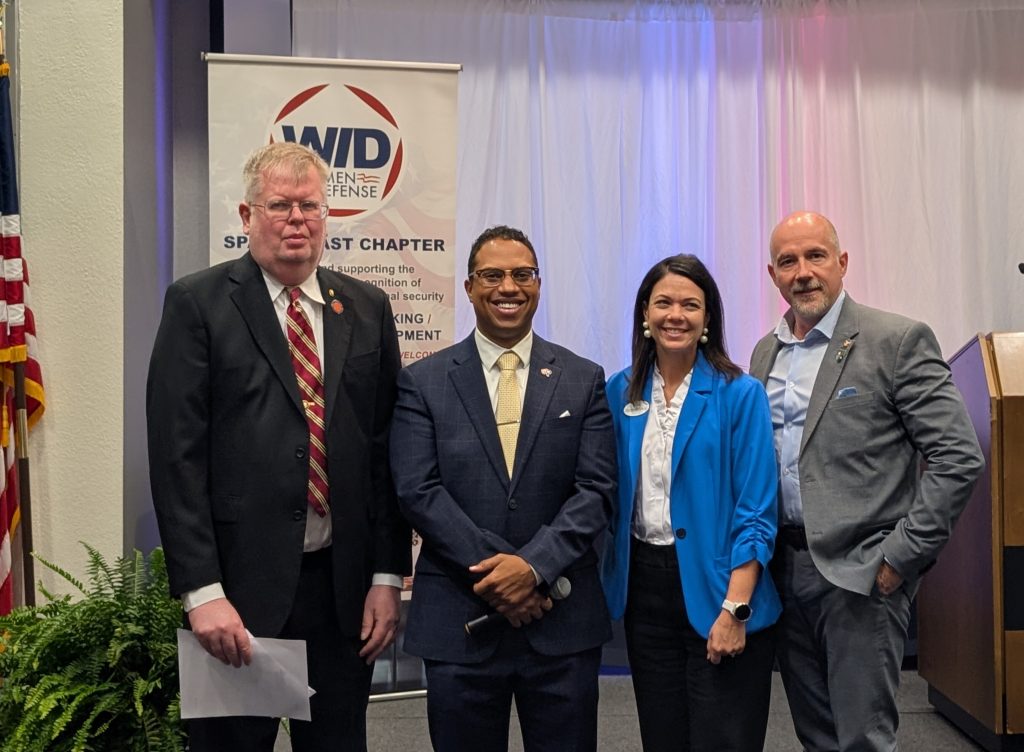
🎙️ Cordell Rolle Speaks at Space Coast Women In Defense Annual Awards Panel: CMMC, AI, and How to Stay Smart and Secure

At the Women In Defense Space Coast (WIDSC) Annual Awards Event, Rolle IT’s CEO Cordell Rolle joined an expert panel of cybersecurity and compliance leaders to unpack the evolving challenges of CMMC (Cybersecurity Maturity Model Certification) and Artificial Intelligence (AI). The panel brought together perspectives from across the industry and was expertly moderated by David Bragg from the University of Florida.

Cordell spoke alongside:

  • Reagan Edens, Chief Technologist and Founder at DTC Global
  • Elizabeth Huy, VP of Business Operations at Alluvionic
  • David Bragg, Moderator and Cybersecurity Programs Director, University of Florida

Together, they tackled some of the most urgent and nuanced topics facing the defense industrial base and government contractors today.


🔐 CMMC: Building a Culture of Compliance, Not Just Checking Boxes

The panel opened by reinforcing the mission behind CMMC:

“CMMC isn’t a hurdle — it’s a shield. It’s how we protect our nation’s supply chain, intellectual property, and the future of our industrial base.”

The panel addressed real-world concerns many small and mid-sized contractors face:

  • Confusion around what level of CMMC is required for subcontractors
  • Cost implications of CMMC Compliance and Assessments- which should have already been factored into contract prices
  • Companies looking to “just get compliant” without understanding the risk landscape

Cordell emphasized education and empowerment, not fear-mongering:

“We can’t just talk about compliance as a cost. It’s a capability. It tells our partners we’re ready, responsible, and reliable.”


🤖 AI & Compliance: Smart Technology Needs Smarter Boundaries

The conversation then shifted to Artificial Intelligence — one of the most anticipated and complicated topics of the evening.

Cordell discussed how AI can be a powerful force multiplier in cybersecurity, automating detection, correlation, and even response in ways humans can’t match. But he also cautioned against blind adoption:

“You can’t use just any AI tool in a compliant environment. You need to know exactly where your data is going — and who owns it once it leaves your network.”

One key insight from Cordell: Using AI within your controlled environment — not as an external, public tool — may be the only way to remain compliant under frameworks like CMMC, NIST 800-171, and DFARS.

He challenged companies to ask:

  • Is the AI processing data locally or in the cloud?
  • Is the model trained on your proprietary information — and if so, how is it secured?
  • Can you control retention, deletion, and auditability?
  • Who has access to your prompts, responses, and metadata?
  • How are permissions set for access to information within your environment?

“AI isn’t the enemy — it’s your responsibility. If you can’t explain where your information is going, then you’re not compliant. And you’re definitely not secure.”


🧠 Key Takeaways from the Panel

This year’s WIDSC event brought together government leaders, defense tech innovators, women in STEM, and cybersecurity trailblazers. Cordell’s message was clear:

CMMC compliance is achievable — if you start early and build smart habits
AI should be internalized, audited, and tested before use in sensitive environments
Zero trust applies to software too — especially those with autonomous learning
Education is the strongest defense — and free, public guidance must continue


💬 The Bigger Picture: Rolle IT Leads With Purpose

Cordell Rolle’s panel appearance reflects a broader principle at Rolle IT: We don’t just offer cybersecurity solutions — we help shape the cybersecurity conversation.

From supporting small DIB contractors to contributing on non-sponsored expert panels, Rolle IT shows up where it counts — with practical advice, not a sales pitch.

To learn more about how we support compliant AI adoption, CMMC readiness, and cyber risk reduction, visit us at https://rolleit.com.

Not Just Talking CMMC — Leading Efforts Read More »

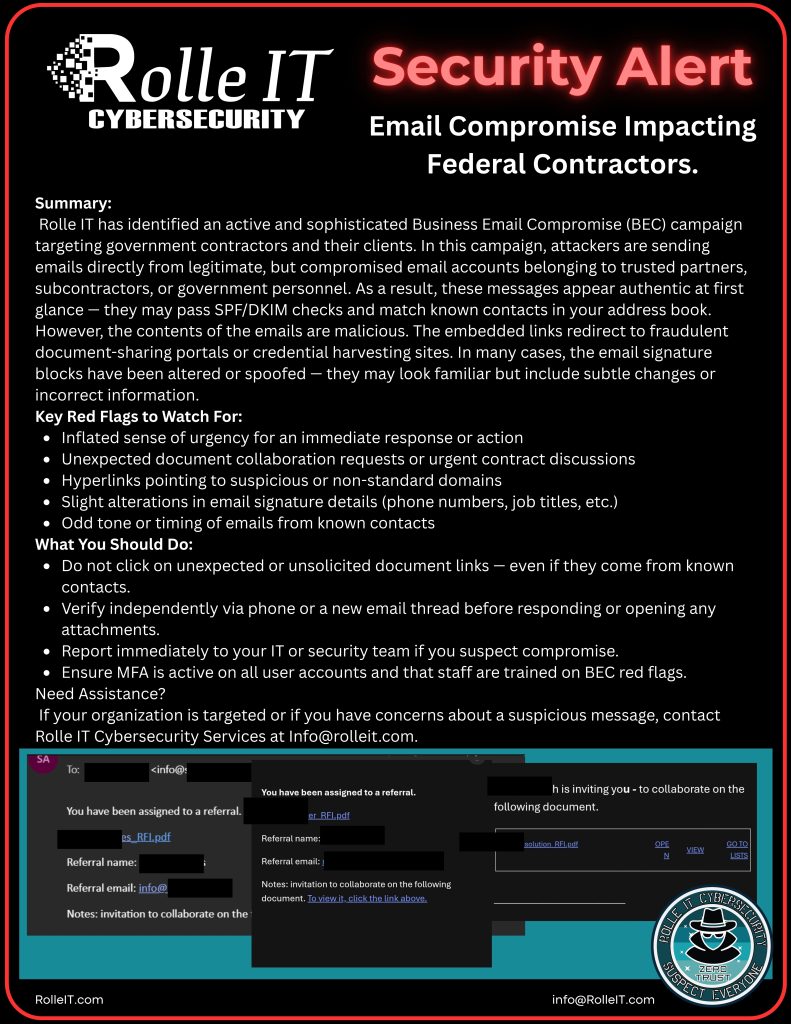
It’s not actually an invite to collaborate.

🚨 Security Alert: Business Email Compromise (BEC) Campaign Targeting Government Contractors
Date: June 17, 2025
Threat Level: High
Audience: Government Contractors and Client Partners

Summary:
Rolle IT has identified an active and sophisticated Business Email Compromise (BEC) campaign targeting government contractors and their clients. In this campaign, attackers are sending emails directly from legitimate, but compromised email accounts belonging to trusted partners, subcontractors, or government personnel. As a result, these messages appear authentic at first glance — they may pass SPF/DKIM checks and match known contacts in your address book.

However, the contents of the emails are malicious. The embedded links redirect to fraudulent document-sharing portals or credential harvesting sites. In many cases, the email signature blocks have been altered or spoofed — they may look familiar but include subtle changes or incorrect information.

This compromise prompts users to log into their OneDrive, allowing the bad actors access to critical systems and accounts.

Key Red Flags to Watch For:

Inflated Sense of urgency to complete a task
Unexpected document collaboration requests or urgent contract discussions
Hyperlinks pointing to suspicious or non-standard domains
Slight alterations in email signature details (phone numbers, job titles, etc.)
Odd tone or timing of emails from known contacts

What You Should Do:

Do not click on unexpected or unsolicited document links — even if they come from known contacts.
Verify independently via phone or a different communication method before responding or opening any attachments.
Report immediately to your IT or security team if you suspect compromise.
Ensure MFA is active on all user accounts and that staff are trained on BEC red flags.
Ensure you have appropriate Email Security Protection.

Need Assistance?

If your organization is targeted or if you have concerns about a suspicious message, contact Rolle IT Cybersecurity Services at info@rolleit.com.
hashtag#BEC hashtag#receipts hashtag#Rolleit hashtag#cybersecurity hashtag#ITRemediation hashtag#cybersecurity hashtag#emailsecurity

business email compromise warning

It’s not actually an invite to collaborate. Read More »